_edited.png)
.png)
Ceuta and Melilla: Russian-Aligned Narrative Exploitation of the Border Crisis

Updated: Aug 4

Background
On 30 July 2026, thousands of migrants crossed from Morocco into the Spanish enclaves of Ceuta and Melilla, overwhelming local police and triggering an emergency situation. At the time of writing, at least nine people have reportedly died. In response, the Spanish government announced it will deploy its military.[1]
In conjunction with the events on the ground, the information space became a second arena of conflict. Within 24 hours of the first illegal border crossings, CRC researchers identified and analyzed hundreds of posts across X/Twitter and Reddit, spanning eleven languages. The picture that emerged is familiar to anyone who has tracked hostile influence efforts associated with the People’s Republic of China (PRC) and Russia, as well as their usage of strategic communication assets.
Although the events were still unfolding on the ground, they were instantly framed and weaponized, with several conspiratorial narratives quickly proliferated across platforms and key target audiences. The malign messaging was amplified by an existing infrastructure of influencers and online personas, seemingly in an attempt to target European and NATO cohesion.

Narrative Analysis
CRC analysts mapped five core narrative clusters affecting online discourse around the Ceuta border crossings. They were assessed by core framing, relative volume, principal amplifiers, and platform and language distribution. As shown below, securitized and anti-government narratives dominated the information environment, while conspiratorial, geopolitical, and humanitarian framings gained more limited traction.
# | Narrative Cluster | Velocity | Core Framing | Circulation |
N1 | Islamic Military Invasion | High | The crossing as a religiously motivated offensive. A conquest of European or Christian civilization. Focus on reported violence, looting, and home invasions. | European/American far right, identitarian accounts and Russian state media. Highly Emotive content and messaging. |
N2 | Sánchez Policy Failure / Open Borders | High | The crossing is due to the Sánchez government’s amnesty policies and the Spanish Supreme Court ruling on maritime returns. Calls for military deployment, border closure, and emergency measures. | Spanish opposition figures, European conservative and populist politicians. Criticism mostly based on policy debate. |
N3 | Israel/US Geopolitical Manipulation | Medium | The border crossing is a false-flag or coordinated retaliatory operation against Spain, in response for its pro-Palestinian position. The goal is to seize control of the Strait of Gibraltar and/or destabilize the EU. | Geopolitical commentators, politically aligned influencers, low-follower accounts. Cross-platform correlation. |
N4 | Morocco Hybrid Warfare / State Pressure | Medium | Deliberate Moroccan weaponization of migration, potentially linked to Spain’s diplomatic ties with Algeria. | Circulates among geopolitical commentators, journalists, and users. Overlaps conspiratorial or extremist framing (N1 or N3). |
N5 | Humanitarian / Decolonization | Low | Presents migrants as people fleeing poverty, characterizes Ceuta and Melilla as colonial remnants, and depicts the European response as hypocritical or disproportionate. | Amplified by pro-Moroccan and left-leaning accounts. “Ceuta is Morocco” framing also observed on Reddit. |

Conspiracies Hotbed
The most analytically significant narrative observed in our dataset claims that the Ceuta crossing was a covert operation coordinated by Israel and the United States, designed to punish Spain for its pro-Palestine foreign policy and wrest Spanish control of the Strait of Gibraltar, a critical chokepoint for Atlantic-Mediterranean maritime traffic.
The main "evidence" cited is a 2019 tweet by Yair Netanyahu, son of the Israeli Prime Minister, in which he referenced potential Israeli funding of NGOs in Ceuta and Melilla as counter leverage against Spain. Although that tweet itself is indeed real, it was taken out of context to serve as “proof” for the alleged hostile foreign led “invasion”.

This claim, along with the misattribution of recent statements made by President Trump and other US officials, are clear examples of DISARM ‘Technique T0042: Seed Kernel of Truth’, by which malinformation is used to “promote a narrative less common in the target audience, but preferred by the attacker.”[2]
The conspiratorial narrative achieved measurable traction. One post framing the crossing as a joint US-Israel operation to seize the Strait of Gibraltar gained millions of views and was retweeted over 4,400 times.

Another, attributing the “operation” to "Spanish intelligence" and claiming a Moroccan false flag, reached 2,943 retweets. Neither claim has any basis in public record or official statement.
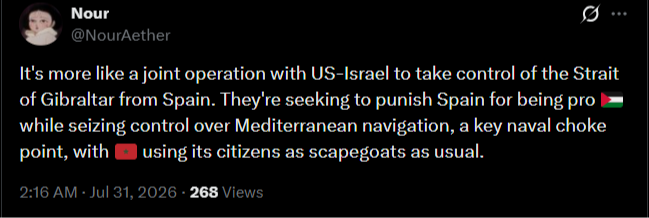
The Strait of Gibraltar framing does not appear to be incidental. Weakening Western cohesion and control of strategic maritime routes – and particularly Spain's position as part of NATO’s southern flank – is a Russian strategic objective.

Having said that, the narrative did not need to directly originate in Moscow in order to serve its interests. It was repeated and reframed even by self-proclaimed pro-European politicians and geopolitical commentators.
State Aligned Media
It’s worth noting the active role of Russian state media outlets in the propagation and amplification of inflammatory messaging and conspiratorial narratives. For example, Russia Today (RT), which is sanctioned and blocked in the European Union, chose to cover highly contentious posts by leading Western figures, emphasizing narratives of Western fragmentation and decline among a mostly non-Western audience.

The observed selective coverage aligns with the familiar modus operandi of pro-Russian groups and the supportive influence infrastructure. Russian media outlets, doubling as overt influence assets, consistently frame geopolitical developments to fit a specific set of meta-narratives (e.g. Western civilizational decline; Failure of European societies; Progressive liberalism as an existential threat to Europe’s future). To do that, Russian propaganda outfits do not have to generate disinformation. Instead, they exploit actual events. In addition, Russian propaganda is delivered through a wide framing and amplification ecosystem, in which fringe theories are laundered toward legitimacy through pseudo-journalistic sources.
Why This Matters
This preliminary analysis does not seek to minimize the gravity of the events unfolding in the Spanish enclaves of Ceuta and Melilla. Morocco’s use of border management as political leverage is well documented, while Spain’s Supreme Court ruling and 2026 amnesty program warrant legitimate policy scrutiny.
However, these debates are increasingly being distorted by unsubstantiated conspiracy theories. Claims attributing the border crisis to coordinated U.S., Israeli, and Moroccan offensive plans lack credible evidence and risk diverting attention from the actors, policies, and structural pressures directly involved. Such narratives clearly serve the strategic interests of geopolitical rivals, primarily Russia, China, and Iran, by deepening mistrust and contempt toward Western governments and institutions.
What began in Ceuta and Melilla on 30 July as a local border crisis has already generated diplomatic, political, and societal repercussions extending far beyond the contested territories. Although the full implications remain unclear, the current crisis must also be assessed through its digital-cognitive dimension, where competing narratives already amplify tensions, reshape public perceptions, and influence geopolitical actions.
[References:]
CNN. Spain declares emergency in Ceuta after thousands of Moroccans cross into enclave. [online] Published 30 July 2026. Available at: https://edition.cnn.com/2026/07/30/europe/ceuta-emergency-thousands-moroccans-intl (Instagram)
DISARM Foundation. T0042: Seed Kernel of Truth. [online] Available at: https://github.com/DISARMFoundation/DISARMframeworks/blob/main/generated_pages/techniques/T0042.md (disarm.foundation)


