_edited.png)
.png)
Mad MAX: The Kremlin’s Attempt at Complete Information Control

Updated: Mar 17

Telegram and the Authoritarian Control Paradox
Authoritarian regimes increasingly seek information dominance by nationalizing or tightly regulating digital communication platforms. Yet attempts to exert comprehensive narrative control frequently encounter a structural constraint: the same platforms these regimes seek to suppress are operationally indispensable.
Russia’s ongoing effort to suppress Telegram exemplifies this paradox. The popular messaging platform simultaneously serves as Russia’s top propaganda distribution channel, a battlefield communication medium, and a vector for hostile influence campaigns (HICs). At the same time, it remains a largely uncontrolled information space capable of exposing clandestine military activity and information operations, facilitating internal dissent, and enabling intelligence collection.
As the Kremlin escalates pressure on Telegram, promoting a state-controlled alternative messenger platform, it exposes the inherent tension between operational pragmatism and the innate need for complete information control, which characterizes authoritarian regimes’ information governance policies.
Asserting Information Dominance
Modern information dominance is pursued through legal, technical, and infrastructural measures, designed to consolidate control over the domestic information environment. China, Iran, and Russia have each implemented increasingly restrictive policies aimed at regulating digital communication. These measures include platform bans, strict censorship, content moderation, legislation that restricts online expression, and even overall internet shutdowns.
Despite variations in implementation, these approaches all share three key strategic objectives:
Consolidating state oversight over the national information space
Limiting channels for adversarial influence and foreign intelligence activity
Restricting the outward flow of politically or militarily sensitive information
In that context, messaging platforms such as WhatsApp and Telegram have become frequent targets of regulatory limitations, technical disruption, or formal bans.
However, these same platforms are widely used by state actors and state-aligned threat actors to conduct influence operations, espionage, and cyber-enabled activities. Telegram in particular has emerged as a central infrastructure for HICs and hybrid operations, due to its popularity, anonymity features, and permissive moderation standards.
Russia vs. Telegram
Telegram occupies a uniquely ambiguous position in Russia’s information ecosystem. It functions simultaneously as a vibrant domestic media environment, a practical communications tool for military forces, and a major source of tactical intelligence.
Due to its unregulated nature, Russian authorities have increasingly moved to constrain the platform. As of February 2026, the state communications regulator Roskomnadzor introduced a series of phased restrictions against Telegram, citing the company’s alleged noncompliance with domestic legislation, refusal to remove content deemed extremist, and failure to comply with data localization requirements. As of early March 2026, Telegram still remains accessible to the overwhelming majority of Russian users. Authorities have demonstrated a sustained pattern of selective, regionally-targeted throttling, consistent with their broader strategy of graduated digital coercion.
In response, Telegram's founder, Pavel Durov, publicly defied coercive regulatory pressure, reaffirming the platform's commitment to user privacy. Russian courts imposed punitive financial sanctions against Telegram.
The escalation intensified on February 24, 2026, when Russian authorities opened a criminal case against Durov himself on charges of "aiding terrorism", a charge Durov publicly rejected on his @durov Telegram channel, where he described the Russian state's conduct as the daily fabrication of "new pretexts to restrict Russians' access to Telegram" in pursuit of suppressing "the right to privacy and free speech" characterizing it as "a sad spectacle of a state afraid of its own people".


A State-Sponsored Usurper
In parallel to its applied pressure, the Kremlin has promoted a domestic alternative to foreign messaging platforms: MAX, a messenger platform developed by VK (formerly Mail.ru Group).

Designed as a multifunctional “super-app” comparable to China’s WeChat, MAX integrates messaging, social networking, financial services, and e-government functions into a single state-aligned ecosystem. Since 2025, the application has been mandatorily preinstalled on new devices sold within Russia.

In comparison with Telegram, assessments regarding MAX’s actual adoption within Russia differ greatly. VK has reported more than 50 million registered users by late 2025, roughly corresponding to the number of downloads recorded on the Google Play Store. Independent estimations, however, suggest that actual active usage may be significantly lower.

Regardless of precise adoption rates, the Kremlin’s strategic objective is clear: replace unruly communication platforms with a domestically governed digital infrastructure that allows the state complete visibility and control over public discourse and financial transactions.
Why Telegram Still Matters
Battlefield Communications and Intelligence
At the tactical level, Telegram has become a primary conduit for Russian battlefield coordination. In fact, it is so indispensable to Russian forces that the Minister for Digital Development explicitly exempted usage in warzone areas (i.e., the Ukrainian front) from the nationwide restrictions.
This dependency on Telegram has been recently exposed and worsened by Ukraine's successful degradation of Russian Starlink access at the front, which deepened Russia's communication dependencies at a moment when state authorities are escalating regulatory pressure.
Aside from its benefits for combat communications, Telegram is also used for intel gathering purposes:
It is considered a feed of open-source intelligence (OSINT), where troop movements, battlefield imagery, and operational details circulate across channels accessible to any actor.
Its open-access structure, which permits users to contact any other user without prior connection, lends itself to the deployment of botnets for passive intelligence collection or proactive human intelligence (HUMINT) based operations.
A Disinformation Hotbed
According to multiple reports, Telegram has become a primary distribution channel for Russian propaganda and HICs targeting both domestic and foreign information environments, respectively.
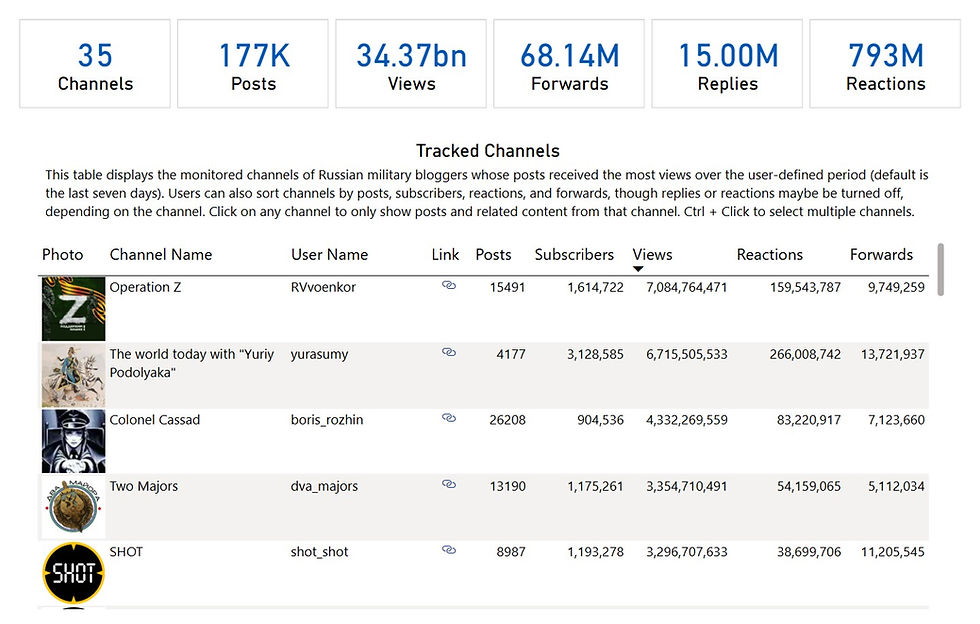
The European Union’s ban on several Russian state-aligned media outlets solidified Telegram’s role as a key platform for continuous narrative dissemination across European audiences. These ongoing activities are not limited to official state channels. A whole ecosystem of proxy accounts, alternative media networks, and coordinated messaging campaigns amplifies Russian narratives across multiple languages and platforms.

In October 2023, Foundation for Defense of Democracies (FDD) adjunct fellow Ari Ben Am uncovered a campaign that targeted Ukrainian soldiers with coordinated surrender narratives disseminated across Telegram, WhatsApp, Signal, and Facebook. According to his findings, the manipulative messaging originated from Russian Telegram channels and was subsequently amplified in both German and French, exemplifying the multilingual, cross-platform reach of Russia's Telegram channels.
Another prominent example is the Telegram channel “War on Fakes.” Although it presents itself as an independent fact-checking initiative debunking disinformation, the channel consistently promotes pro-Kremlin narratives. With more than 410,000 followers, the channel has repeatedly circulated misleading claims about the war in Ukraine.

A Comparative Model
Like Russia, the Islamic Republic of Iran has also pursued a sovereign national internet model designed to reduce dependence on foreign digital infrastructure. However, Iran’s system still relies on certain Western services. A January 28, 2026, report by Filter Watch indicated that authorities gradually permitted access to select platforms such as Google, Bing, and ChatGPT due to the absence of domestic alternatives.

However, according to Filter Watch: “Regarding social media and messaging platforms, Instagram, Telegram, YouTube, and X remain accessible only through circumvention tools and continue to suffer from instability.”
Telegram itself has been formally banned in Iran since 2018 following its role in the 2017–2018 protest movement. Nevertheless, as in Russia, the platform remained widely used among Iranian citizens.

Like Russia, Iran has also used Telegram for hostile influence efforts and intelligence gathering abroad. Following the October 7 attacks, Iranian-linked threat actors reportedly increased the scale of their Telegram-based HUMINT and hybrid operations targeting Israel.
The main difference between Russia and Iran lies in enforcement methods. Historically, Iran has had to resort to nationwide internet shutdowns to assert its information control in times of increased threat to the regime’s stability. The three total blackouts (enacted by Iran in June 2025, January 2026, and March 2026) are emblematic of Tehran’s concerns about uncontrolled information flows. Attempts by journalists and civil society actors to bypass Iran’s January 2026 blackout using Starlink terminals proved largely unsuccessful, illustrating the regime’s ability to enforce physical control over connectivity infrastructure.
In comparison, Moscow has mostly managed to avoid drastic and highly disruptive measures. Instead, it has opted for more targeted techniques (e.g., specific protocol blocking, traffic throttling, and regional restrictions). In addition, Russia has invested in developing substitutes to key foreign (and especially Western) digital platforms, including its own search engine, AI tools, and online communication apps. An important dimension of such infrastructural consolidation is the large-scale deployment of DNS tampering. By systematically deleting domain records from the National Domain Name System (NSDI), Russian authorities render targeted domains, including bbc.com, youtube.com, and torproject[.]org, entirely non-existent within the Russian information space.
Strategic Liabilities and the Limits of Information Control
Despite its beneficial functionality, Telegram is perceived by Russian authorities as a malign threat. In the long term, it has the potential to facilitate sensitive information leaks while hosting the largest digital space outside of the Kremlin’s control. At present, the existing widespread usage of Telegram by the Russian populace creates valuable opportunities for external actors looking to inject narratives into Russian information spaces.
When comparing Russia and Iran, the two authoritarian nations present distinct variations of the same structural dilemma. Russia currently preserves selective access to Telegram due to critical dependencies. Iran prioritizes stricter control, even at the cost of nationwide shutdowns and the economic-reputational disruption they generate.
For now, Telegram remains a contested arena within authoritarian information environments: a tool of state power with inherent strategic vulnerabilities for the regimes that rely on it.
The CRC would like to thank Ari Ben Am, FDD’s CCTI Adjunct Fellow and co-founder of Telemetry Data Labs, and Dr. Daria Dergacheva, for their contribution to this analysis.
[References:]
Alliance for Securing Democracy at the German Marshall Fund. (2026). The War in Ukraine: Military Bloggers Dashboard. Retrieved March 10, 2026 from: https://securingdemocracy.gmfus.org/war-in-ukraine-military-bloggers/
Source: BBC, O. Chia & B. Tavener. Russia orders block on WhatsApp in messaging app crackdown. [online] Published 12 February 2026. Available at: https://www.bbc.com/news/articles/clygd10pg5lo
TIME, V. Bergengruen. Telegram Becomes a Digital Battlefield in Russia-Ukraine War. [online] Published 21 March 2022. Available at: https://time.com/6158437/telegram-russia-ukraine-information-war/
Global Voices, D. Dergacheva. Inside-net: Russia is dismantling free internet connections. [online] Published 7 October 2025. Available at: https://globalvoices.org/2025/10/07/inside-net-russia-is-dismantling-free-internet-connections/
FDD, R. Easter. What Russia’s War on Telegram Means for the West. [online] Published 23 February 2026. Available at: https://www.fdd.org/analysis/2026/02/23/what-russias-war-on-telegram-means-for-the-west/
Filter Watch, N. Keshavarznia. Network Monitoring January 2026: Internet repression in times of protest. [online] Published 24 January 2026. Available at: https://filter.watch/english/2026/01/24/network-monitoring-january-2025-internet-repression-in-times-of-protest-2/
Filter Watch, N. Keshavarznia. A Month of Iran’s Internet: From Regional Disruptions to Total Blackout and Whitelisted Access. [online] Published 28 January 2026. Available at: https://filter.watch/english/2026/01/28/network-monitoring-january-2026-from-regional-disuptions-to-total-blackout-and-whitelisted-access/
Freedom House. Freedom on the Net 2025: Russia. [online] Published 2025. Available at: https://freedomhouse.org/country/russia/freedom-net/2025
Institute for National Security Studies (INSS), N. Yasur & D. Citrinowicz. Iranian Foreign Information Manipulation and Interference During the Swords of Iron War. [online] Published 12 November 2024. Available at: https://www.inss.org.il/publication/iran-influence/
IStories, L. Lemyasova. The MAX state messenger announced 45 million users. These are probably mostly “dead souls”. [online] Published 15 October 2025. Available at: https://istories.media/news/2025/10/15/gossmessendzher-max-zayavil-o-45-mln-polzovatelyakh-veroyatno-v-osnovnom-eto-mertvie-dushi
FDD, D. Shapiro & K. Korkiya. SpaceX Blocks Russia’s Starlink Access but Ubiquiti’s Tech Remains Ubiquitous. [online] Published 6 February 2026. Available at: https://www.fdd.org/analysis/2026/02/06/spacex-blocks-russias-starlink-access-but-ubiquitis-tech-remains-ubiquitous/
OpenAI. Disrupting Malicious Uses of AI Report. [online] Published 25 February 2026. Available at: https://openai.com/index/disrupting-malicious-ai-uses/
OpenMinds. The Kremlin Connection: Mapping Telegram Networks in Russia, Ukraine, and Belarus. [online] Published 8 January 2026. Available at: https://telegram-network.openminds.ltd
M. Wang & P. Lin & J. Knockel & W. Greenberg & J. Mayer & P. Mittal. Proceedings on Privacy Enhancing Technologies, 2025(4) pp.896–911. What WeChat knows: Pervasive first-party tracking in a billion-user super-app ecosystem. [online] Published 2025. Available at: https://petsymposium.org/popets/2025/popets-2025-0163.pdf


